A mattress collects more than most people want to think about: sweat, skin cells, dust mites, the occasional spilled coffee and, in houses with kids or pets, worse. You cannot put it in the washing machine, and most of us never learned how to clean a mattress properly, so it gets a vacuum once a year at best.
The good news is that cleaning a mattress well takes an afternoon, a vacuum and a few things you already have in the kitchen. This guide covers the full routine, how to get specific stains out, and how to deodorize and sanitize. It also covers what changes when your mattress is memory foam, hybrid, innerspring, latex, or one with a cover you can simply unzip and wash.
Summary
- You do not wash a mattress. You vacuum it, spot clean stains, deodorize with baking soda and let it dry completely, every six months or so.
- Match the cleaner to the stain: hydrogen peroxide for sweat and blood, an enzyme cleaner for urine and vomit, baking soda for odors. Keep bleach and steam away from foam.
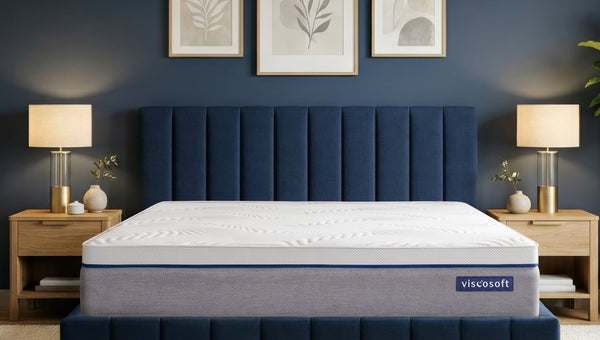
- The easiest mattress to keep clean is one whose cover comes off and goes in the washing machine, which is how the Viscosoft Edge mattresses are built.
Viscosoft's insight
Almost every mattress cleaning mistake comes down to too much liquid. Foam soaks it up, holds it, and grows mold where you cannot see. Spray lightly, blot instead of scrubbing, and give the mattress a full day to dry before you make the bed.
What you need to clean a mattress
You do not need a special mattress cleaner. Most of the products sold under that name are a mild detergent or an enzyme solution in a spray bottle, and a homemade mattress stain remover works just as well. Gather these before you start:
- A vacuum with an upholstery attachment and a crevice tool
- Baking soda, a full box
- Mild dish soap
- White vinegar
- 3% hydrogen peroxide, the standard brown bottle from the pharmacy
- An enzyme cleaner, the kind sold for pet stains, for urine, vomit or anything old
- Clean white cloths or paper towels, and a spray bottle
Skip bleach, carpet shampoo and anything that foams up. Bleach breaks down foam and discolors fabric, and foaming cleaners leave residue that attracts more dirt.
How to clean a mattress step by step
People searching how do I wash a mattress are usually hoping for something simpler than this. There is no shortcut, but the best way to clean a mattress is not hard either. The whole routine fits into a morning, as long as the mattress has the rest of the day to dry.
- Strip the bed and wash everything. Sheets, pillowcases, protector and mattress pad all go in the wash on the hottest setting the label allows. Do this first so the clean bedding is ready by the time the mattress is dry.
- Vacuum the whole surface. Use the upholstery attachment and go slowly, in overlapping strokes, across the top and down the sides. Use the crevice tool along the seams and in the quilting, where dust mites and skin cells collect. This is the step that does the most for allergies.
- Spot clean the stains. Treat each stain with the right cleaner for its type, which is covered in the next section. Spray or dab lightly, blot with a clean cloth, and never pour liquid straight onto the mattress.
- Deodorize with baking soda. Sprinkle a generous, even layer over the entire surface and leave it for at least 30 minutes. Several hours is better, and if you can leave it all day with a window open, better still. Baking soda pulls moisture and odor out of the top layer of the mattress.
- Vacuum again. Remove every trace of baking soda, going over the surface twice. Any that stays behind turns gritty under the sheets.
- Let it dry and air out. Leave the mattress bare with the window open or a fan running until every treated spot is completely dry to the touch, and then give it a couple more hours. Sunlight helps on most mattresses, but not on latex, which is covered below.
- Put a protector on before the sheets. A washable mattress protector means the next clean is a load of laundry rather than an afternoon on your knees.
That last step is the one that saves you from repeating all the others. The Active Dry mattress protector is waterproof, machine washable and thin enough that you do not feel it, and it stops sweat, spills and dust mites from ever reaching the mattress.
How to get stains out of a mattress
The method depends on what made the stain. Protein stains like sweat, blood and urine need cold water and either hydrogen peroxide or an enzyme cleaner. Heat sets them, so never use hot water on any of these. Whatever you use, test it first on a corner of the mattress, because hydrogen peroxide can lighten colored fabric.
| Stain | What to use | How |
|---|---|---|
| Sweat, yellowing | Hydrogen peroxide paste | Mix 1 cup of 3% hydrogen peroxide, 3 tablespoons of baking soda and a drop of dish soap. Spray or dab on, leave until dry, vacuum. |
| Urine, fresh | Vinegar and water, then baking soda | Blot up as much as possible. Spray a 1:1 vinegar and water mix, blot again, cover with baking soda for several hours, vacuum. |
| Urine, dried or old | Enzyme cleaner | Spray enough to dampen the stain, leave for the time on the bottle, usually 10 to 15 minutes, blot, let dry. Repeat for the smell if needed. |
| Blood | Cold water, then hydrogen peroxide | Blot with cold water first. Dab 3% hydrogen peroxide on, let it fizz for a few minutes, blot with a clean cloth. Never use warm water. |
| Vomit | Vinegar and water, then enzyme cleaner | Scrape off solids, blot, spray 1:1 vinegar and water, blot, then treat with enzyme cleaner for the odor. Baking soda overnight. |
| Coffee, wine, food | Dish soap and water | A few drops of dish soap in a cup of cool water. Dab, blot, repeat. Follow with a light vinegar spray if a ring remains. |
| Unknown or set-in stain | Enzyme cleaner, then peroxide paste | Start with the enzyme cleaner. If the mark remains once dry, use the peroxide paste. Expect two or three rounds on an old stain. |
Sweat stains on a mattress
Those yellow-brown clouds on an older mattress are sweat and body oil, and they are the most common mattress stain by a wide margin. The hydrogen peroxide mattress stain paste in the table above is the fix. Spread it thinly, let it dry completely, which can take a few hours, and vacuum off the residue. On a mattress that has gone yellow all over rather than in patches, two full rounds usually bring it back to near white.
Cleaning a mattress of urine
Speed matters more than anything else here. Fresh urine blots out and rinses out with the vinegar method. Urine that has soaked in and dried has broken down into compounds that vinegar and soap cannot touch, which is why the smell comes back on humid nights. An enzyme cleaner for mattress stains breaks those compounds down. Use enough to reach as deep as the urine did, keep the area damp for the time the bottle says, and let it dry naturally. Rushing it with a hair dryer stops the enzymes working.
Old stains and stains you cannot identify
Start with the enzyme cleaner, because it is safe on everything and handles most organic stains. If a mark remains once the mattress is dry, follow with the peroxide paste. Old stains come out in stages, not in one go, so plan on repeating the treatment a day apart rather than drowning the mattress in one session.
Viscosoft's insight
Blot, do not rub. Rubbing pushes the stain deeper into the foam and frays the fabric on top. Press a clean cloth down firmly, lift, move to a clean part of the cloth, and repeat until nothing more transfers.
How to clean each type of mattress: memory foam, hybrid, latex and more
The routine above works for every mattress. The details that change are how much moisture the mattress can take, whether sunlight is safe, and whether any part of it can come off and go in the washing machine.
| Mattress type | Safe | Avoid | Drying |
|---|---|---|---|
| Memory foam | Vacuum, light spot cleaning, baking soda, sun | Soaking, steam, bleach, high heat | Slow. Air dry 24 hours, hair dryer on cool only |
| Hybrid | Same as memory foam on the top, firmer vacuuming on the sides | Steam on the foam layer, flipping | Slow on top, faster through the coil base |
| Innerspring | Vacuum, spot cleaning, baking soda, sun, careful steam | Soaking the padding, letting water reach the coils | Moderate. Stand it on its side to air both faces |
| Latex | Vacuum, mild soap and water, baking soda, shade and airflow | Direct sunlight, which breaks latex down, and harsh cleaners | Slow. Indoors with a fan, never outside in the sun |
| Pillow-top | Vacuum deep into the quilting, spot clean, baking soda | Flipping (one-sided), heavy liquid in the quilted layer | Slow in the quilting. Rotate head to foot after cleaning |
| Removable-cover (modular) | Unzip and machine wash the cover, vacuum and air the layers | Washing the foam itself, drying the cover on high heat | Fast. The cover dries on the line while the foam airs |
How to clean a memory foam mattress
Memory foam is the one that needs the most care, because it works like a sponge. For how to clean memory foam mattress surfaces, keep every step light: vacuum, spot clean with a barely damp cloth, dab rather than spray, and use baking soda for odors. If a spot gets wet, press dry towels into it to pull out as much moisture as you can. Cover it with baking soda for a few hours, vacuum, and finish with a hair dryer on the cool or low setting, held a few inches away. High heat softens and can warp the foam. Bleach and solvents break it down, so stick with soap, vinegar and peroxide.
Sunlight is fine for memory foam and speeds up drying, so if you can get the mattress outside for an afternoon, do. Just make sure it is bone dry before it goes back on the frame, because damp foam under a sheet is how mattresses end up smelling musty for good.
The easiest mattress to clean is one that comes apart
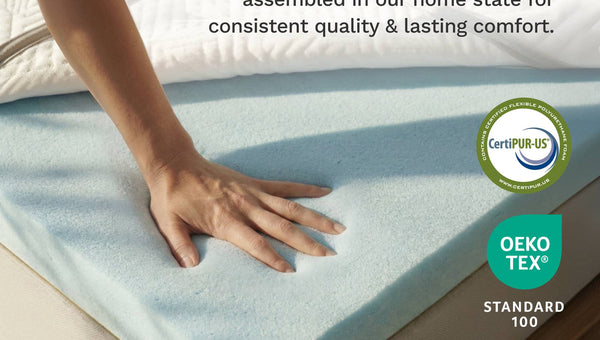
Every method above exists because the dirty part of a mattress is sewn to the rest of it. A modular mattress removes that problem. On the Viscosoft Edge, the cover unzips and goes in the washing machine, which takes care of sweat, dust mites and most spills with no scrubbing at all. Underneath, the 3-inch comfort layer lifts out, so you can air it, vacuum it and get to any spot that soaked through, then zip the clean cover back on. The Edge Signature works the same way with a removable, machine-washable moisture-wicking cover over a 3.5-inch layer. Follow the washing and drying instructions on our care page, and the cover comes back clean without the mattress ever leaving the frame.
How to deodorize a mattress
Most mattress smells are sweat, trapped moisture or the foam itself. The fix for all three is the same: baking soda and air. Anyone searching for how to clean a mattress with baking soda is really looking for this step. For baking soda mattress odor treatment, cover the whole surface, not just the smelly spot, leave it for as many hours as you can spare, and vacuum it off. Baking soda is slightly alkaline, which neutralizes the acidic compounds in sweat rather than masking them.
For a stubborn smell, add a light mist of 1:1 white vinegar and water before the baking soda and let it dry first. The vinegar smell disappears as it dries and takes the other smell with it. Then open the windows and leave the mattress bare for the day. If you can get it outside into the sun, a few hours of sunlight helps with both smell and moisture on everything except latex.
What does not work is perfume, fabric spray or scented powders. They sit on top of the smell for a day and then you have two smells.
How to sanitize or disinfect a mattress
You might want to sanitize a mattress after an illness, before a guest arrives, or because you have just bought a used one. Whatever the reason, the goal is to reduce bacteria, dust mites and allergens without soaking the mattress. Vacuuming thoroughly removes most dust mites and the skin cells they feed on. A baking soda treatment deals with moisture and odor. A few hours of direct sunlight helps with some of what is left.
For a disinfecting step on top of that, lightly mist the surface with a 1:1 mix of rubbing alcohol and water, or with white vinegar, and let it air dry. Both evaporate quickly and leave no residue. Do not use bleach or disinfectant wipes on a mattress, and do not saturate it with any disinfectant spray. The moisture does more harm than the germs.
If you are working out how to clean a used mattress, inspect every seam and the underside for bed bugs before it comes into the house, since no amount of cleaning fixes that. Our guide to bed bug protection covers what to look for and how an encasement protector works. If the mattress is clean of pests, run the full routine above, then put an encasement protector on it so whatever is left stays sealed away from you.
Can you steam clean a mattress?
Sometimes, and it depends entirely on what the mattress is made of. Steam kills dust mites and lifts stains on an innerspring mattress with a thin fabric top. Keep the steamer moving, and let the mattress dry fully afterwards, which takes most of a day.
On memory foam, and on most hybrids with a thick foam comfort layer, do not steam clean, as the table in the previous section shows. Steam pushes moisture deep into the foam where it cannot evaporate, and the heat can soften or warp the foam. Some foam mattress warranties exclude damage from steam cleaning and carpet cleaning machines for exactly this reason. The same goes for the rental carpet cleaners people drag onto a mattress: they put far more water in than they pull out.
If you own a steamer and a foam mattress, use it on the bed frame, the headboard and the mattress protector instead.
How often should you clean a mattress, and when is a stain beyond cleaning?
Vacuum the mattress every month or two when you change the sheets, and do the full routine, stains, baking soda and a day of airing, every six months. Rotate the mattress head to foot at the same time if the brand allows it, so you are not sleeping in the same spot year after year. With a protector on, most mattresses never need more than that.
Some stains are beyond cleaning, though. Liquid that has soaked through the comfort layer into the core, mold inside the foam, or a smell that comes back after two full treatments all mean the same thing. The damage is below the surface, where no cleaner reaches. On a conventional mattress, that is a new mattress.
On a modular one, it is a new layer. If a comfort layer on an Edge is ruined, an Edge replacement comfort layer swaps in and the base, which is where the soaked-through liquid rarely reaches, stays. It is the same answer whether the layer was ruined by a pet accident or worn out by years of use. That is also why these mattresses make sense in a house with young children or pets. Both models come in twin XL, queen and king.
Do you need a mattress vacuum or a professional cleaning service?
Usually not. A mattress vacuum cleaner is a handheld vacuum with a UV light and a vibrating head, sold for dust mites. The suction does the work, and the upholstery attachment on your regular vacuum does the same job. The UV light passes over each spot for a fraction of a second as you move the head, and there is little evidence that such a brief pass does much. Spend the money on a good protector instead.
A mattress cleaning service makes sense in a few cases. A stain or smell has survived two rounds of home treatment. The mattress has been wet through. Someone in the house has a serious dust mite allergy. Or the mattress is one you cannot physically move and air yourself. Ask what equipment they use before booking. A service that uses hot water extraction on a memory foam mattress will do more damage than the stain did.
Viscosoft's insight
If a mattress has been wet through, dry matters more than clean. Stand it on its side in front of a fan for two full days before you decide whether it is salvageable. A mattress that still smells damp after that has mold inside and should go.
Protect the mattress so you clean it less
Everything in this guide gets easier, or unnecessary, with a protector between you and the mattress. Sweat, dust mites, skin cells and spills stop at the protector, which goes in the wash every couple of weeks with the sheets. The mattress protector collection covers waterproof, cooling and encasement styles in every size, and our guide to the best protector for a memory foam mattress explains which type suits which bed.
If you use a topper, it needs the same care as the mattress and the protector goes over both. Our guides on caring for a mattress topper and getting rid of topper odors cover the differences.
FAQ
How do you wash a mattress?
You do not, at least not with water the way you wash sheets. A mattress is cleaned by vacuuming it, spot treating stains with a lightly applied cleaner, and covering it with baking soda to draw out moisture and odor. Then you vacuum again and let it air dry for a full day. Soaking a mattress or running a carpet cleaner over it leaves water inside the foam or padding, where it grows mold.
Can you use hydrogen peroxide on a mattress?
Yes, and it is the best home remedy for sweat and blood stains. Use the 3% solution from the pharmacy, not a stronger one, and mix it with baking soda and a drop of dish soap into a thin paste. Test it on a hidden corner first, because peroxide can lighten colored fabric. Apply thinly, let it dry fully and vacuum off the residue. It is safe on memory foam as long as you do not saturate the foam.
How long should you leave baking soda on a mattress?
At least 30 minutes, and ideally several hours. Baking soda keeps drawing out moisture and odor for as long as it sits there, so a short treatment freshens the surface while an all-day one deals with deeper smells. Spread it evenly over the whole mattress, not just the problem area, then vacuum it off thoroughly. For a strong smell, repeat the next day rather than leaving it a week.
How do you get urine out of a memory foam mattress?
Blot first, hard, with dry towels to pull out as much liquid as you can before it sinks in. Then dab on a 1:1 mix of white vinegar and water, blot again, and cover the area with baking soda for several hours before vacuuming. For a stain that has dried, or a smell that lingers, use an enzyme cleaner and let it air dry on its own, since heat stops the enzymes working. Never soak the foam or use steam on it.
Can you use a carpet cleaner on a mattress?
Not on memory foam or a hybrid, and only with great care on an innerspring. Carpet cleaning machines put far more water in than they extract, and the water that stays behind sits in the padding or foam for days. On a thin innerspring mattress with a fabric top, a quick pass with minimal water and a full day on its side in front of a fan can work. On anything with a foam comfort layer, stick to spot cleaning.
How do you clean a used mattress?
Check it for bed bugs before anything else: look along every seam, under the labels and on the underside for small dark spots or live insects. If it is clear, vacuum it thoroughly, treat any stains and cover it in baking soda for the day. Air it in the sun if it is not latex, and put an encasement protector on it before you use it. If it has a smell you cannot get out after two treatments, or any sign of mold, it is not worth keeping.
How do I clean the cover of a memory foam mattress?
If the cover unzips, wash it on a gentle cycle in cold or warm water with mild detergent. Air dry it or use low heat, since a hot dryer can shrink the knit and damage any waterproof backing. If the cover is sewn on, treat it as part of the mattress and spot clean it. Check the care label or the brand's care page first, because some covers are not meant to be removed at all even if they have a zipper.
Does sunlight clean a mattress?
It helps. A few hours of direct sun dries out moisture, reduces odor and kills some of the dust mites and bacteria near the surface. It is a useful last step after a deep clean for memory foam, hybrid and innerspring mattresses. Keep latex out of the sun, though, because ultraviolet light breaks natural latex down and leaves it crumbly, and bring any mattress in before the evening damp sets in.
Final takeaway
Cleaning a mattress comes down to a vacuum, baking soda, a few household cleaners and patience while it dries. Match the cleaner to the stain, keep liquid to a minimum, never put steam or bleach near foam, and do the full routine every six months.
The simplest way to clean a mattress less often is a washable protector over the top. And when you next buy a mattress, consider one whose cover unzips and whose comfort layer comes out. Then a spill is a load of laundry and a ruined layer is a replacement part. That is how our modular mattresses are built, and it is the difference between a mattress you clean around and one you can clean all the way through.